
presents

Materials North America
Copper and Brass Sales
The Future of Red Metal Strip Forming: Precision Processes for High-Tech Industriesby Tom McClenahan
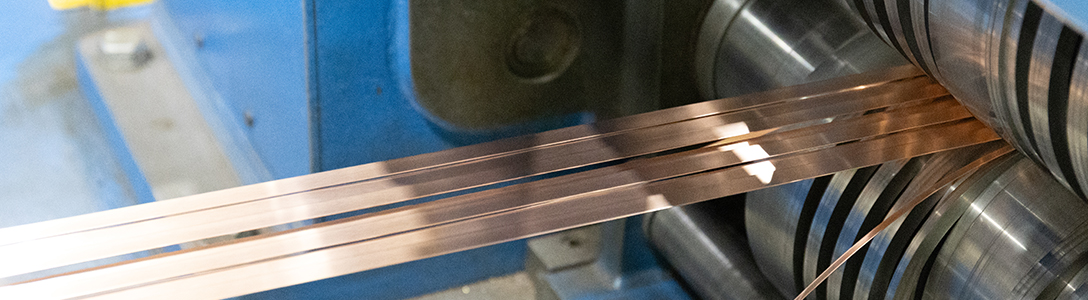
From electric vehicles to next-generation aerospace systems, industries are pushing components to do more in less space, without compromising reliability. Connectors must carry higher currents without overheating. Terminals and relays must endure constant cycling under heat and vibration. Miniaturized circuits must maintain flawless conductivity at microscopic scales.
Meeting these demands isn't just about material properties; it's about how manufacturers process those materials. Precision forming techniques like rolling, stamping, and machining unlock the true potential of red metals, transforming them into high-performance components that drive innovation. Advances in automation, in-line inspection, and computer-aided design now make it possible to achieve levels of consistency, efficiency, and complexity once thought of as out of reach.
At Copper and Brass Sales, we recognize that precision in process begins with a reliable foundation. By preparing red metal strip for today’s most sophisticated processes, we help manufacturers realize new levels of performance, efficiency, and reliability.
Precision Forming Meets the Demands of Modern Electronics
In high-tech applications across industries, the same challenge exists; components must be smaller, smarter, and longer lasting. Red metal strip is essential for making that possible, powering the connectors, relays, lead frames, and circuits that keep high-tech systems running.
Miniaturization adds urgency to precision forming. At smaller scales, even microscopic flaws can undermine conductivity or reliability. That’s where advanced rolling, stamping, and machining come in, delivering smooth surfaces, accurate tolerances, and complex geometries that ensure flawless performance across millions of cycles. In this way, forming isn’t just about shaping metal; it’s about enabling the next wave of technology.
Smarter Forming Processes Driving the Future
Forming has evolved into highly engineered, data driven processes that drive performance and efficiency. In today’s fast moving industrial sector, the methods used to roll, stamp, and machine red metals directly impact on how well they conduct electricity, maintain structural integrity, and integrate into increasingly compact designs. Advances in digital integration, robotics, and precision tooling have pushed these processes further, helping manufacturers achieve tighter tolerances, faster cycle times, and reduced scrap.
Innovations in Metal Rolling
Metal rolling is one of the foundational methods of strip processing, but today it does much more than create uniform thickness. Modern rolling doesn’t just shape strip; it fine-tunes the material itself. Tight gauge control, stress mapping, and enhanced surface finishes all contribute to better product performance and ensure success in stamping, machining, and downstream assembly.
Today’s high-precision fabrication techniques can create variable profiles across a single strip, reinforcing high-stress zones while thinning others to reduce weight – ideal for components that demand strength without sacrificing efficiency. Specialized tooling can pre-form grooves, ribs, and multi-gauge contours directly into copper alloy strip, eliminating secondary operations and enabling parts like telescopic tubes or connector housings to withstand high wear without additional processing.
In electronics, telecommunications, and other high-tech applications, these benefits are even more pronounced. Ultra-thin gauge coil materials preserve conductivity in signal-carrying circuits, deliver smoother surface finishes that protect delicate components from abrasion or interference, and maintain dimensional accuracy to support ongoing miniaturization. As demand grows for lighter, smarter, and more compact devices, precision rolling remains a key technology enabler, supporting innovation across industries.
Advances in Metal Stamping
Metal stamping is a cold-forming process that uses a press and custom dies to shape flat sheets or coils of metal into precise, often complex forms. Techniques such as blanking, bending, and punching transform metal strip into finished parts with speed and repeatability. This makes stamping especially valuable for high-volume, high-precision applications, like producing thin connectors for electronics.
Recent innovations like progressive die stamping have dramatically improved efficiency. In this method, a strip moves through a series of dies in one continuous operation, with each stage adding a feature until the final part is complete. The result is faster production, fewer handoffs, and a sharp reduction in time and resource use.
The outcome is stamping lines capable of producing large amounts of identical, high-precision parts. That level of reliability at scale translates into less rework, stronger supply chains, and a decisive cost advantage.
Modern Metal Machining
When product designs demand extreme complexity, tight tolerances, or features that rolling or stamping can’t produce, machining becomes essential. Unlike rolling or stamping, machining removes material to create geometries, cavities, and compound angles no other process can match. Innovations in multi-axis CNC systems, CAD/CAM integration, and in-process inspection allows machining to evolve into a process that’s not just precise but also faster, more repeatable, and increasingly sustainable.
In aerospace, medical, and other high-value industries, machining delivers components where every gram and every micron can affect performance or compliance. Machining allows engineers to optimize red metal components, such as copper, brass, and bronze, for conductivity, strength, and reliability, even in mission-critical environments. Whether it’s producing tight-tolerance housings for avionics, high-conductivity contacts for surgical equipment, or intricate thermal components for defense systems, advanced machining extends the capabilities of red metals into the most demanding applications of the modern age.
Precision as a Catalyst for High-Tech Applications
The impact of precision forming extends across industries:
- Automotive: Rolled, stamped, and machined copper alloy strip is critical in both internal combustion and electric vehicles. As cars become more computerized and sensor-driven, advanced forming processes produce the precise components needed for airbags, tire-pressure monitoring systems, next-generation haptics for driver interfaces, and real-time diagnostics that keep vehicles operating at peak performance. In electric vehicles, copper demand is even higher, providing key properties for batteries, inverters, motors, and charging ports – all of which rely on strip engineered through precision forming to meet demanding electrical and thermal requirements.
- Electronics: As devices shrink, ultra-thin circuits and miniature connectors depend on the tight tolerances enabled by advanced rolling and stamping. At these scales, even microscopic inconsistencies can compromise performance and reliability.
- Aerospace: Aircraft and spacecraft systems require wiring, connectors, and thermal management solutions that perform reliably in extreme conditions. Precision forming transforms copper strip and its alloys into components that combine conductivity, corrosion resistance, and malleability with the strength and accuracy needed for high-temperature, high-stress environments.
- Medical Devices: As medicine becomes more digital and data-driven, copper strip enables electronic systems that demand flawless signal transmission and effective heat dissipation. Miniaturization raises the bar even higher. Advanced forming processes allow copper to support compact, high-performance circuits – from wearable sensors to surgical robotics – driving the intelligence, responsiveness, and speed required by next-generation healthcare.
These are not just incremental improvements; they are enabling technologies. Without innovations in precision forming, the next generation of electrification, mobility, aerospace, and medical advancements would not be possible.
Copper and Brass Sales: Your Partner in Precision Manufacturing
At Copper and Brass Sales, we supply more than material; we supply readiness for precision. Our coil processing services, including slitting, annealing, re-rolling, traverse winding, and edge conditioning that prepare strip for the next stage of production. By ensuring consistency and quality at every step, we help manufacturers get the most from their stamping, rolling, or machining operations.
Beyond material preparation, we also offer CNC machining and other forming services in-house, giving customers a faster path to finished parts. This combination of supply, processing, and technical expertise makes us a trusted partner for manufacturers pushing the boundaries of performance.
As industries continue to demand smaller, faster, and stronger technologies, Copper and Brass Sales remains committed to enabling progress through precision forming.
Have Questions? We’re Here to Help
Need more details about the materials, products, or services on this page? Fill out the form below, and one of our experts will provide the answers you’re looking for. Whether you need a custom quote or guidance on the right material for your project, we’re ready to assist.

Smaller, Faster, Stronger: Copper Alloys for Electronics and Sensors
From smartphones and electric vehicles to medical wearables and industrial sensors, today’s electronic devices are becoming...
Enhancing SCADA-Driven Power Management with High-Performance Copper Strip
SCADA (Supervisory Control and Data Acquisition) is a technology that enables real-time monitoring, automation, and system control as a...

Powering the Future: How Copper Supports AI, Data Centers, and Emerging Technologies
As artificial intelligence (AI) and cloud technologies transform industries, the energy demands of data centers are surging at an unprecedented pace.