
presents

Materials North America
Copper and Brass Sales
Steel and Aluminum Tariffs in 2026: A Definitive Guide for US Manufacturersby Leigh Glazer

Last Updated: August 26, 2026
On March 12, 2025, the United States enacted a large tariff increase on steel and aluminum imports, raising duties to 25% across all trading partners. This policy shift has sparked debate among industry leaders, policymakers, and international trade organizations. While the goal is to bolster domestic manufacturing and strengthen national security, it has also introduced concerns about higher production costs, supply chain adjustments, and broader global trade implications.
For answers to the most common questions about 2025/26 steel and aluminum tariffs, check out our Steel and Aluminum Tariffs FAQ.
Most Recent Update:
US Section 232 tariffs on steel and aluminum continue to evolve, with recent changes affecting how certain products and materials are treated. June updates introduced reduced rates for certain products, temporary 25% treatment for specified steel and aluminum articles, and a lower threshold for qualifying US-origin metal. More recently, additional tariffs on certain Canadian goods took effect in August 2026; however, steel and aluminum products already covered by Section 232 are generally excluded from these additional duties. Businesses that source materials across the US-Canada border should continue to monitor product classifications and country-of-origin requirements, as evolving trade measures may influence material costs, sourcing strategies, and supply-chain planning.
Tariffs are taxes placed on imported goods to influence market dynamics, regulate trade flows, control foreign competition, and protect domestic industries. They serve multiple functions, from revenue generation to addressing economic imbalances. By making imported goods more expensive, tariffs encourage domestic production but can also contribute to inflationary pressures and trade disputes. The recent escalation of tariffs on steel and aluminum in the US aligns with these goals, with a particular focus on reducing foreign reliance and supporting American manufacturers.
These tariff adjustments form part of a wider trade enforcement strategy that integrates multiple legislative frameworks, including Section 232 of the Trade Expansion Act, the International Emergency Economic Powers Act (IEEPA), and Section 301 of the US Trade Act of 1974.
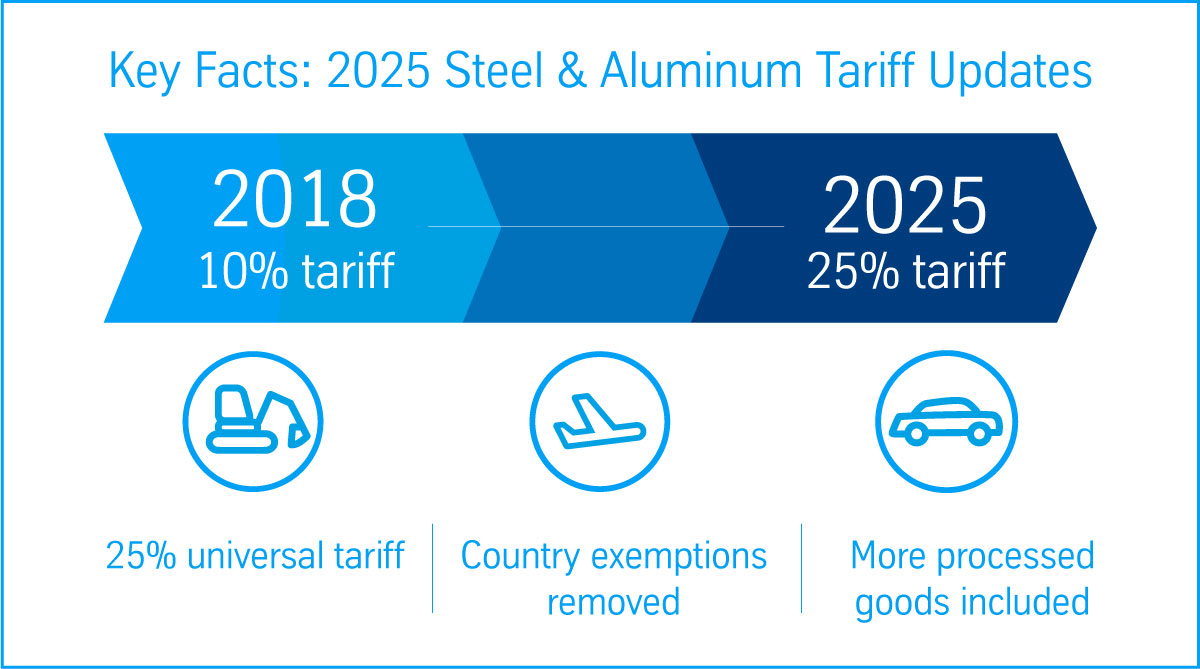
In place since 2018, Section 232 allows the government to impose tariffs on imports considered a threat to national security, initially introducing duties on steel and aluminum. The 2025 update removes earlier country exemptions and applies the tariff universally.
Understanding the Recent US Tariff Increases
In
recent years, the US has adopted an increasingly assertive stance on trade
policies, particularly in the metals sector. The government intends for tariffs
on aluminum and stainless steel to combat global overproduction, counter unfair
trade practices, and decrease reliance on foreign suppliers. The latest policy
updates mark a fundamental shift, ending earlier exemptions, broadening the
scope of covered products, and raising tariffs to 25% on key metal imports.
These regulatory changes carry significant implications for supply chains,
manufacturing competitiveness, and global trade relations.
As
mentioned above, there are three policies primarily affecting tariffs and
metals trade. These tariff taxes can
compound upon each other, increasing the impact significantly, potentially
taxing materials 100% or more of the original cost.
Three Key Trade Regulations Affecting Aluminum and Stainless Steel Imports
- Section 232:
National Security-Based Tariffs
Section 232 of the Trade Expansion Act of 1962 authorizes the president to impose tariffs on imports that may pose a national security threat. In the case of steel and aluminum, these materials are considered essential for defense systems, military vehicles, infrastructure, and energy production. A heavy reliance on foreign suppliers could compromise the United States ability to respond to military or emergency needs.
Initially invoked in 2018, the government implemented a 10% tariff on steel and aluminum imports to safeguard domestic production capacity, with exemptions granted to select countries. The 2025 expansion removes those exemptions and applies the tariffs universally, reinforcing the objective of maintaining a stable, self-sufficient supply of critical metals vital to national defense and strategic industries. - IEEPA: Economic
Sanctions and Trade Control
Unlike Section 232, which focuses on protecting national security through import restrictions, the International Emergency Economic Powers Act (IEEPA) grants the president broad authority to regulate trade during a declared national emergency involving foreign threats. Governments typically use this law to impose economic sanctions against specific nations, corporations, or individuals they consider security risks. While not a tariff-focused law, IEEPA enables the government to block imports or freeze assets linked to nations or entities deemed hostile or destabilizing.
In the context of metals trade, IEEPA has been used to restrict aluminum and steel imports from sanctioned countries, particularly those accused of supporting adversarial regimes, engaging in unfair trade practices, or compromising global market stability. These restrictions aim to reduce dependence on politically volatile sources and reinforce supply chain security for critical industries.

The Strategic Goals and Economic Implications of Tariffs
What is dumping and why does it matter?

In addition to increased material costs, aerospace manufacturers must also consider the impact on research and development budgets. Higher input costs could limit the financial flexibility of firms looking to invest in next-generation aircraft technologies, lightweight materials, and fuel-efficient designs. This slowdown in innovation could have long-term repercussions for US aerospace competitiveness on a global scale, particularly against manufacturers in Europe and Asia who do not face the same tariff-driven constraints.
To mitigate these challenges, aerospace companies must focus on strategic sourcing, innovation, and operational efficiencies. Potential solutions include forming long-term agreements with domestic suppliers, exploring alternative materials, or shifting certain production processes to tariff-exempt locations. In addition, increased investment in recycling and material optimization could help manufacturers offset some of the rising costs while maintaining production efficiency and safety standards.

The impact of tariffs extends beyond just material costs. Supply chain disruptions caused by shifting import patterns, retaliatory tariffs from trade partners, and delays in securing high-quality raw materials can hinder production schedules. Some companies may need to redesign products to use alternative materials or reduce reliance on metal-intensive components, potentially affecting product quality and longevity.
To counteract these challenges, manufacturers and construction firms must adopt strategic cost-management measures. Companies may invest in advanced manufacturing techniques such as automation and 3D printing to optimize material usage and reduce waste. Forming alliances with domestic suppliers, exploring long-term contracts, and lobbying for policy adjustments could help mitigate the long-term effects of these tariffs. For construction firms, a greater emphasis on prefabrication and modular building techniques could offer cost-effective solutions in an increasingly expensive market.
Overall, while the tariffs aim to bolster domestic steel and aluminum production, they introduce significant hurdles for the manufacturing and construction industries. Firms must navigate rising costs, supply chain disruptions, and potential delays while finding innovative solutions to maintain competitiveness and ensure continued growth in the face of trade policy shifts.
Automotive Industry
The automotive sector is among the most significantly affected industries by the recent 25% tariffs on steel and aluminum imports. These metals are essential for vehicle production, used in everything from chassis and engine components to body panels and structural reinforcements. As automakers grapple with rising raw material costs, the entire industry faces potential challenges, including higher production expenses, disrupted supply chains, and shifts in consumer pricing.
Some major automakers have already indicated that rising steel and aluminum costs could result in price hikes for consumers. This means that popular vehicle models, from trucks and SUVs to sedans and electric cars, may see incremental price increases, making vehicles less affordable for the average buyer. Tariffs may push manufacturers to seek domestic alternatives, but US producers still have limited immediate availability of automotive-grade steel and aluminum, making it difficult to fully offset foreign sourcing.
Many automakers also rely on a global supply chain, sourcing steel and aluminum from various countries to ensure a balance between cost efficiency and material quality. With the blanket imposition of tariffs, manufacturers must reconsider their sourcing strategies, potentially turning to domestic suppliers. However, US-produced automotive-grade steel and aluminum may not be available in sufficient quantities to meet demand, which could lead to potential shortages and production delays.
In response, some automakers may look to shift their supply chain strategies, either by renegotiating contracts with domestic suppliers, investing in long-term agreements to lock in pricing, or even moving parts of their manufacturing operations to countries unaffected by the tariffs. These adjustments could lead to added logistical and transportation costs, further adding to the financial strain.
The US tariffs on steel and aluminum are creating significant ripple effects throughout the automotive industry. From increased vehicle costs and supply chain disruptions to potential shifts in production strategies, automakers must navigate a challenging landscape to still be competitive. While the policy aims to strengthen domestic metal production, the unintended consequences may affect manufacturing efficiency, innovation, and consumer affordability. Moving forward, automakers will need to employ strategic planning, cost-management measures, and supply chain diversification to mitigate the long-term effects of these tariffs.
Consumer Goods and Packaging
The new tariffs also affect products like aluminum cans used in the beverage industry. Higher raw aluminum costs increase manufacturing expenses for soft drinks, canned foods, and household products that use aluminum packaging. Consequently, businesses might pass these costs to consumers through higher prices or look for alternative packaging materials.
Similarly, the impact extends to the appliance industry, where products like air conditioners, refrigerators, and other household goods that incorporate steel and aluminum components could see price increases. The added expenses faced by manufacturers may lead to a reduction in product availability, delays in production, and shifts in consumer buying behavior.
These wide-reaching implications highlight the broader economic consequences of tariffs on aluminum and steel. As industries adjust to these challenges, companies must balance cost management, supply chain resilience, and competitive pricing to navigate the evolving trade landscape.
International Trade Implications
In recent times, the implementation of significant tariffs on steel and aluminum imports by the United States has been both controversial and impactful. With a broad application, including a glaring 25% tariff on materials from major trade partners such as China and Canada, these measures aim at reshaping the landscape of international trade and domestic production.

Canada's Steel Industry and Retaliatory Measures
Canada, traditionally a key supplier of steel to the US, faces significant effects from the 25% tariff that now applies to all steel imports. The US levies the tariff on incoming goods, not directly on Canada. However, this policy significantly impacts Canadian steel producers, who now face reduced price competitiveness in their largest export market. With higher costs imposed on their shipments into the US, Canadian manufacturers must contend with narrowed margins, potential loss of business, and long-term uncertainty within an integrated North American supply chain.
In response, Canada has imposed retaliatory tariffs on US goods, as it did in 2018 when the US introduced similar tariffs. These countermeasures target a range of American goods, including agricultural products, manufactured goods, and consumer items. Past Canadian tariffs have included levies on US dairy products, whiskey, ketchup, and even household appliances, measures designed to pressure key industries and political constituencies within the US.
US manufacturers that rely on Canadian raw materials could face increased costs, while American exporters could experience declining sales if Canada limits imports in response. Additionally, businesses on both sides of the border could suffer from prolonged trade disputes, supply chain inefficiencies, and economic uncertainty. This may lead to reduced investment and slower growth in key industries such as automotive manufacturing, construction, and heavy machinery.
Beyond immediate economic impacts, prolonged trade tensions could strain diplomatic relations between the US and Canada, further complicating negotiations on trade agreements like the United States-Mexico-Canada Agreement (USMCA). Given the deeply interconnected nature of the North American supply chain, retaliatory measures from Canada could have unintended ripple effects across multiple industries, affecting businesses, workers, and consumers in both countries.
Mexico's Trade Challenges Under US Steel and Aluminum Tariffs
Mexico is a key trade partner of the United States and a significant supplier of steel and aluminum. The newly imposed 25% tariffs on these imports create considerable challenges for Mexican manufacturers and exporters. Many of these firms depend on access to the US market, particularly in industries such as automotive, construction, and industrial equipment manufacturing. With tariffs increasing costs, Mexican steel and aluminum producers may struggle to maintain competitive pricing, potentially leading to a decrease in exports to the US.
The automotive sector shows vulnerability to these trade barriers. Mexico serves as a major hub for automotive manufacturing, supplying parts and finished vehicles to the US market. With increased costs on steel and aluminum, Mexican auto manufacturers face rising production expenses, which could lead to higher vehicle prices for US consumers. Automakers may need to either absorb these added costs, reduce their margins, or pass them on to buyers. This situation could affect vehicle affordability and sales, particularly in price-sensitive segments of the market.
Furthermore, disruptions in Mexico's automotive supply chain could affect major US automakers that rely on components manufactured south of the border. Many US-based car manufacturers have extensive operations in Mexico, where they source key materials and assemble critical vehicle parts. The tariffs could lead to production slowdowns, potential job losses, and investment reductions in the sector.
In response to these tariffs, Mexico has considered implementing retaliatory measures like its actions in 2018, when the country imposed duties on US agricultural products, machinery, and household goods. Mexican businesses that rely on US steel and aluminum imports for manufacturing may also need to seek alternative suppliers or adjust production strategies. These changes could potentially affect labor markets and overall economic stability.
Beyond direct trade implications, tariffs could strain diplomatic relations between Mexico and the US, particularly in the context of the United States-Mexico-Canada Agreement (USMCA). With the North American supply chain highly integrated, increased costs and restrictions could disrupt industries dependent on seamless cross-border trade, making collaboration and negotiation essential for mitigating long-term consequences.
China-US Trade Tensions and the Impact of Steel and Aluminum Tariffs
China is one of the world's largest producers of steel and aluminum, and US tariffs on these materials are largely aimed at curbing the influx of Chinese imports. The 25% tariff presents a significant barrier for Chinese exporters, reducing their competitiveness in the US market. This move is part of broader trade tensions between the two nations, with the US seeking to protect domestic industries from what it views as unfair trade practices, such as government subsidies and overproduction in China leading to dumping.
China has historically responded to US tariffs with retaliatory measures, targeting American agricultural products, technology, and consumer goods. The latest round of tariffs could further escalate trade disputes, leading to more countermeasures that may impact global supply chains and economic relations between the two countries.
For US manufacturers that rely on Chinese steel and aluminum, the increased tariffs may lead to higher costs and difficulties in securing alternative sources. Some businesses may try to shift supply chains to other countries, but this transition could take time and come with its own set of challenges. Companies operating in industries such as electronics, construction, and heavy machinery may see increased expenses passed down through the supply chain, affecting both businesses and consumers.
As tensions persist, both the US and China will need to navigate complex trade negotiations to prevent prolonged economic instability. The future of trade relations between the two countries is still uncertain, but businesses affected by the tariffs will need to adapt to changing regulations, explore alternative sourcing options, and develop strategies to mitigate financial impacts.
Impact on Domestic Steel and Aluminum Production
A central goal of the US tariffs is to bolster domestic industries by encouraging companies to ramp up local production of steel and aluminum. While this potentially helps American producers by reducing foreign competition, there are intrinsic challenges. Domestic suppliers might struggle to scale operations quickly enough to meet demand due to the need for substantial investments in infrastructure, workforce training, and raw materials.
Although the government intends the tariffs to protect American jobs in the steel and aluminum sectors, the broader economic impact could have both positive and negative effects. Industries that rely on these metals will face higher input costs, which may force them to cut jobs or reduce hiring as they try to balance their increased expenses. The true impact on employment remains uncertain while metal production may see job growth, those gains could be offset by reductions in metal-dependent industries.
The imposition of steel and aluminum tariffs by the US is a significant intervention in international trade practices and domestic economic strategies. While aimed at strengthening domestic industries, the reality presents a complex tableau of potential trade wars, shifts in global market dynamics, and internal economic adjustments. As the situation evolves, stakeholders in both the international and domestic arenas will need to navigate these turbulent waters with strategic foresight and adaptable policies.
Looking Ahead: How Will Tariffs Affect the Economy?
As the US implements these tariffs, several key questions remain: Will domestic production of steel and aluminum grow quickly enough to reduce dependence on imports? How will global trade partners respond, and will retaliatory measures hurt US exports? What long-term effects will these tariff policies have on industries that depend on imported metals?
The full impact of these tariffs will unfold in the coming months and years, shaping the landscape of US manufacturing, trade relations, and economic policy. We will only discover whether these measures achieve their intended goals or lead to unintended consequences over time, but they undoubtedly mark a significant shift in the nation's trade strategy.

Conclusion
The latest round of US steel and aluminum tariffs is a pivotal moment in the nation's trade strategy, with far-reaching effects on domestic production, international relations, and consumer markets. Designed to bolster American manufacturing and reduce dependence on foreign metals, these policies could create opportunities for domestic suppliers but also pose challenges for industries reliant on imported materials.
For the metals industry, the tariffs may lead to increased investment in US steel and aluminum production, potentially creating jobs and strengthening supply chains. However, scaling up domestic manufacturing takes time, and in the short term, businesses may struggle with rising costs and supply chain disruptions. Industries such as aerospace, automotive, construction, and consumer goods will likely face higher raw material prices, which they could pass on to consumers in the form of price increases.
On the global stage, these tariffs have already led to retaliatory measures from key trade partners, including Canada, Mexico, China, and the European Union. Escalating trade disputes could harm American exporters, further complicate international supply chains, and strain diplomatic relations. As companies adapt to these new realities, policymakers and economists will closely watch the effectiveness of the tariffs in achieving their intended goals, reducing unfair competition, protecting national security, and strengthening domestic industry.
Looking ahead, the long-term impact of these policies is still uncertain. While they aim to create a more self-sufficient and competitive US metals industry, they also introduce economic risks that could ripple through various sectors. Businesses must prepare for ongoing market fluctuations, explore alternative sourcing strategies, and remain agile in navigating the evolving trade landscape. Whether these tariffs serve as a catalyst for industrial growth or a barrier to economic stability will depend on how industries, policymakers, and global trade partners respond in the coming years.
To address specific questions you might have, consult our Steel and Aluminum Tariffs FAQ.
Have Questions? We’re Here to Help
Need more details about the materials, products, or services on this page? Fill out the form below, and one of our experts will provide the answers you’re looking for. Whether you need a custom quote or guidance on the right material for your project, we’re ready to assist.
Historical Changes
- April 15, 2026: As of April 2026, US tariffs on steel and aluminum remain unchanged at 50% under Section 232. The existing scope, including the expanded list of derivative products introduced in 2025, continues to apply across downstream industries. Sectors such as automotive, construction, and heavy equipment manufacturing are still managing elevated material costs and ongoing sourcing adjustments. Recent legal developments related to tariffs imposed under the International Emergency Economic Powers Act (IEEPA) have not resulted in any modifications to Section 232 steel and aluminum measures. While the Supreme Court is still considering consolidated cases addressing the executive branch’s authority to impose broad tariffs under IEEPA, these proceedings are not expected to directly affect steel and aluminum tariffs, which are grounded in national security determinations under Section 232. As a result, current duties remain fully in force with no announced changes to rates or coverage.
- March 4, 2026: US tariffs on steel and aluminum remain unchanged at 50% under Section 232. Recent court activity has centered on the Supreme Court’s review of tariffs imposed under the International Emergency Economic Powers Act (IEEPA). Because steel and aluminum duties were implemented through Section 232 national security authority, they are separate from the legal questions being considered in the case. As a result, the ongoing court proceedings are not expected to immediately affect current steel and aluminum tariffs, which remain fully in force.
- February 20, 2026: There have been no changes to existing steel and aluminum tariffs. The current 50% Section 232 duties remain in effect. The US Supreme Court is reviewing a case related to tariffs imposed under the IEEPA, but steel and aluminum tariffs are issued under Section 232 national security authority, which is separate from IEEPA. As a result, the pending decision is not expected to directly affect current steel and aluminum tariffs. A recent House vote concerning certain Canada-related tariffs also does not change existing Section 232 measures.
- January 22, 2026: Since January 7, 2026, US steel and aluminum tariffs remain unchanged at 50% under Section 232, including the expanded coverage of derivative products added in 2025. While a closely watched Supreme Court case is pending on the legality of sweeping tariffs imposed under the International Emergency Economic Powers Act (IEEPA), steel and aluminum tariffs are grounded in Section 232 national security authority and are therefore expected to remain in place regardless of the Court’s eventual ruling.
- January 7, 2026: Currently, US steel and aluminum tariffs continue at 50% under Section 232, with no new adjustments announced. The expanded derivatives coverage introduced earlier this year remains in effect and continues to influence downstream industries such as automotive, construction, and heavy equipment manufacturing. Companies in these sectors are still managing elevated input costs and constrained sourcing options, leading some to modify production planning or supplier strategies.
- December 3, 2025: Since November 12, 2025, US steel and aluminum tariffs remain unchanged at 50% under Section 232. The expanded derivatives list added in August 2025 continues to affect downstream industries, with automakers, heavy-equipment manufacturers, and construction firms reporting ongoing cost pressures tied to tariffed components and structural materials. While the Bureau of Industry and Security is still reviewing potential additions through the inclusion process, no new products have been formally added since August 2025.
- November 12, 2025: Since October 24, 2025, US tariffs on steel and aluminum remain firmly at 50% under Section 232, with no alterations to the standard rate structure. However, advocacy and industry filings indicate increased momentum behind the next round of derivative inclusions, most notably for automobile and heavy-machinery parts made of steel or aluminum, where importers face growing exposure to the inclusion process. Construction and manufacturing firms report ongoing supply-chain strain as higher costs for key materials persist, prompting some to explore sourcing shifts or increased local fabrication.
- October 24, 2025: Since October 15, 2025, US Section 232 tariffs on steel and aluminum imports remain firmly at the 50% rate, with no adjustments announced to the core rate structure. Businesses in the automotive and construction sectors continue to grapple with elevated costs due to the broader tariff reach that added over 400 HTS derivative categories in August.
- October 15, 2025: Since October 8, 2025, US tariffs on steel and aluminum have remained at 50% under Section 232, with no new adjustments to the rates or scope. The expanded derivative list that took effect in August, covering over 400 additional HTS codes, continues to affect a wide range of industries, particularly the automotive, construction, and heavy machinery sectors. These increases have led to extended project timelines and many companies exploring new sourcing strategies or advocating for limited tariff exemptions to ease the impact.
- October 8, 2025: There have been no new substantive changes to the 50% Section 232 tariffs on steel and aluminum since the addition of over 400 HTS codes on August 18, 2025.
- October 3, 2025: The 50% Section 232 tariffs remain unchanged, but recent updates highlight a growing focus on the automotive sector. The Commerce Department is reviewing proposals to expand tariff coverage to a broader range of auto-related products. If approved, this expansion would significantly increase costs for automotive manufacturers and suppliers that rely on imported steel and aluminum inputs, further extending the reach of Section 232 tariffs into downstream industries.
- September 17, 2025: US tariffs on steel and aluminum have remained at 50% under Section 232 with no changes to the core rates. The expansion that took effect on August 18 continues to apply. While legal challenges to the administration’s broader tariff powers under IEEPA are moving forward, these proceedings have not impacted Section 232, and the expanded steel and aluminum tariffs remain firmly in place.
- September 4, 2025: Since August 27, 2025, US tariffs on steel and aluminum have remained at 50% under Section 232, with an expanded scope earlier in the month to include over 400 new HTS codes covering both steel and aluminum derived products. These additions brought a wider range of goods such as fabricated construction materials, fasteners, automotive parts, and certain furniture under the tariff regime. In addition, the 50% Section 232 tariff on semi-finished copper products that took effect in August, further broadening coverage across critical metals. At the same time, US federal court challenges questioning the administration’s broader tariff authority under the International Emergency Economic Powers Act (IEEPA) have introduced legal uncertainty.
- August 27, 2025: US tariffs on steel and aluminum remain at 50% under Section 232, with a significant expansion in product coverage taking effect August 18, 2025. The expansion comes from the Commerce Department adding more than 400 new HTS codes to the Section 232 derivatives list, extending duties to a wider range of finished and semi-finished goods. These include categories such as fabricated structural components, fasteners, wire products, and certain household and industrial equipment that incorporate steel or aluminum. In parallel, the 50% Section 232 tariff on semi-finished copper products, including pipes, wires, sheets, and fittings, implemented on August 1, 2025, reflects a continued effort to broaden tariff measures across critical metal categories. Fore more information on the copper tariff, refer to our article The 2025 Copper Tariff: What US Manufacturers Need to Know.
- August 13, 2025: Since August 6, 2025, the US government has not announced any new updates to tariffs. US tariffs on steel and aluminum remain unchanged at 50% with no new rate adjustments announced. The 50% tariff on semi-finished copper products, including pipes, wires, sheets, and copper-intensive derivatives also remains in effect following its August 1 implementation, while key raw materials like ores, concentrates, cathodes, and scrap are excluded. These measures continue to reflect the government’s focus on protecting domestic metal industries and strengthening supply chain resilience.
- August 6, 2025: Effective August 1, 2025, the US implemented new copper tariffs under section 232. This new tariff applies to semi-finished copper products including pipes, wires, rods, tubes, and copper derivative goods. Notably, refined copper including ores, cathodes and more are exempt. The government has not updated steel or aluminum tariffs, with the rate remaining at 50% for all countries except the United Kingdom.
- August 4, 2025: Since July 23, 2025, US tariffs on steel and aluminum have remained unchanged at 50% under Section 232, with UK-origin imports continuing at a reduced 25% rate following recent meetings between President Trump and Prime Minister Keir Starmer. The government still plans to implement the 50% tariff on select copper products including refined copper, cathodes, and copper alloys on August 1 under Section 232. In a recent Truth Social post, President Trump reaffirmed his commitment to reciprocal trade measures and indicated support for a potential 10% universal baseline tariff on all imports. Additionally, President Trump announced a new 25% tariff on Indian imports, also set to take effect August 1, citing concerns over India's trade practices and its continued purchases of Russian military and energy supplies (Truth Social post). While discussions with China continue, the administration has not introduced any new formal tariff actions for Chinese goods.
- July 28, 2025: Since July 15, 2025, there have been no new changes to US steel and aluminum tariffs under Section 232, with the 50% rate still in effect and the United Kingdom continuing under a temporary 25% rate. Although the 90-day suspension period ended on July 9, the government has not announced any adjustments to those tariffs. However, a significant development is set for August 1, when a new 50% tariff on select copper products, including refined copper, cathodes, and copper alloys, will take effect under Section 232.
- July 16, 2025: As of July 9, 2025, the US government announced a new 50% tariff under Section 232 on select copper products including refined copper, cathodes, and copper alloys confirmed to take effect on August 1, 2025. This marks a broader expansion of trade protections to critical metals beyond steel and aluminum. US tariffs on steel and aluminum remain at 50% under Section 232, with no changes announced following the expiration of the 90-day tariff suspension period. The United Kingdom continues to operate under a reduced 25% rate as part of the US–UK Economic Prosperity Deal, although final implementation of tariff-rate quotas is still pending.
- July 10, 2025: Since June 18, 2025, U.S. tariff policy on steel and aluminum has expanded to cover a wider range of finished goods. As of June 23, steel-containing appliances such as refrigerators and dishwashers are now subject to the 50% Section 232 tariff based on their metal content. Additionally, starting June 28, aluminum imports without verifiable smelting or casting origin are subject to a 200% tariff. Looking ahead, new tariffs on select copper products are scheduled to take effect in August 2025, with details expected to be finalized in early July.
- June 18, 2025: The US government has not announced any new updates on steel and aluminum tariffs since the June 4th increase to 50% under section 232. The United Kingdom continues to maintain the temporary exemption, keeping a 25% rate amid ongoing trade talks. Discussions and negotiations with key trading partners remain underway.
- June 11, 2025: There have been no further changes to US steel or aluminum tariffs beyond the June 4th increase to 50% under Section 232. The United Kingdom remains temporarily subject to a reduced 25% rate under the US–UK Economic Prosperity Deal. Trade negotiations with both the UK and China are ongoing, officials have not announced any new tariff adjustments.
- June 4, 2025: As of June 4, 2025, the US has doubled its tariffs on imported steel and aluminum from 25% to 50% under Section 232, citing national security concerns and the need to protect domestic industries. The United Kingdom is temporarily exempt, maintaining a 25% tariff rate until at least July 9, 2025, pending compliance with the US-UK Economic Prosperity Deal.
- May 28, 2025: As of May 20, 2025, the United States has suspended its planned increase of tariffs on European Union imports, including steel and aluminum, delaying the implementation of 50% tariffs until at least July 9, 2025. During this negotiation period, the current 25% tariffs on EU steel and aluminum remain in place, providing temporary relief for importers while future trade terms are finalized.
- May 21, 2025: Since April 2025, the United States has revised its tariff structure through new agreements with the United Kingdom and China. The deal with the UK replaced the 25% tariffs on steel and aluminum with a quota-based system and reduced tariffs on UK-made automobiles from 25% to 10% for up to 100,000 vehicles annually. In a separate agreement with China, the US lowered tariffs on most Chinese imports from 145% to 30% for 90 days, though tariffs on Chinese steel and aluminum remain unchanged.


Frequently Asked Questions About Steel and Aluminum Tariff Updates
Get clear answers to your most pressing questions about US steel and aluminum tariffs in 2025, including pricing, policy changes, and supply chain implications.

Copper Tariffs: What US Manufacturers Need to Know in 2026
A sweeping new US tariff took effect under Section 232 of the Trade Expansion Act, imposing 50% duties on semi-finished copper products...